
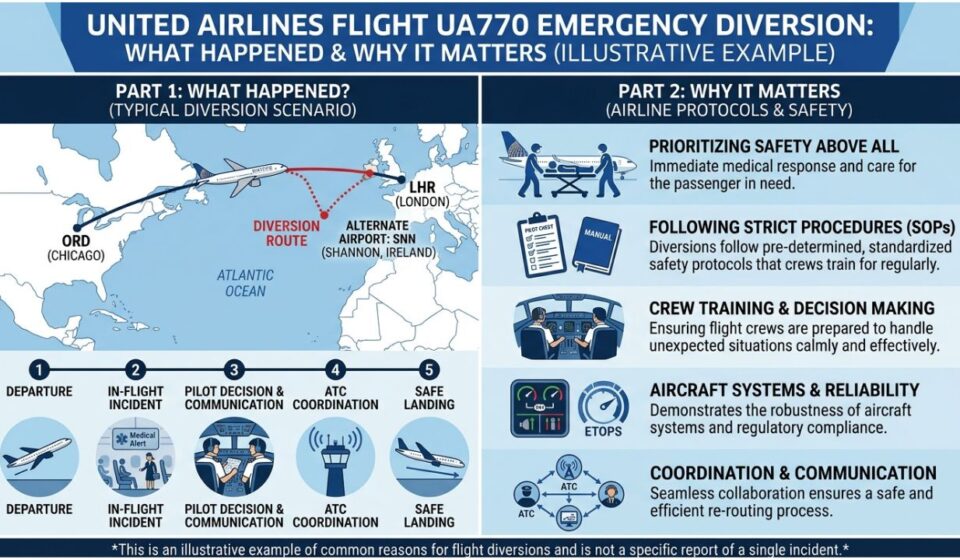
The united airlines flight ua770 emergency diversion refers to a situation where a scheduled United Airlines international flight was forced to change its original route and land at an alternate airport due to an in-flight concern. While the word “emergency diversion” can sound alarming, in modern aviation it often reflects a precautionary safety decision rather than a catastrophic failure. In this case, the flight crew followed standard aviation procedures to ensure passenger safety and aircraft integrity.
The incident gained attention because it involved a long-haul flight operating over European airspace and required coordination between pilots, air traffic control, and emergency services on the ground. Situations like the united airlines flight ua770 emergency diversion highlight how aviation safety systems are designed to respond quickly and effectively to unexpected conditions.
Overview of the United Airlines Flight UA770 Emergency Diversion
The united airlines flight ua770 emergency diversion occurred during a scheduled international journey from Barcelona to Chicago. Mid-flight, the crew identified a technical alert that required immediate assessment. Rather than continuing across the Atlantic, the pilots decided to divert the aircraft to a nearby major airport equipped to handle emergency arrivals.
London Heathrow Airport was selected as the diversion point due to its advanced facilities, long runways, and ability to support wide-body international aircraft. This decision reflects standard aviation practice, where pilots choose the safest and most practical landing location.
Possible Causes Behind the United Airlines Flight UA770 Emergency Diversion
While official airline investigations take time to confirm exact causes, aviation reports and typical industry patterns suggest several possible reasons for such diversions.
Cabin Pressurization Concerns
One of the most critical systems in any aircraft is cabin pressurization. At cruising altitude, air pressure outside the aircraft is too low for human survival without assistance. If the system signals a potential malfunction, pilots must act immediately.
In cases similar to the united airlines flight ua770 emergency diversion, a pressurization warning would require a controlled descent and diversion to the nearest suitable airport.
Technical System Alerts
Modern aircraft are equipped with advanced monitoring systems that continuously check engine performance, hydraulics, and avionics. Even minor irregularities can trigger caution alerts.
Pilots are trained to treat these warnings seriously, even if they do not indicate immediate danger. This conservative approach ensures maximum passenger safety.
Medical or Operational Factors
Although less commonly reported in this specific incident, emergency diversions can also occur due to onboard medical emergencies or operational constraints such as weather rerouting or air traffic restrictions.
How the Flight Crew Handled the Situation
The united airlines flight ua770 emergency diversion demonstrates the importance of professional pilot training and crew coordination in aviation safety.
Communication With Air Traffic Control
Once the decision to divert was made, the flight crew contacted air traffic control to declare an emergency. This ensures the aircraft receives priority routing and that emergency teams are prepared upon landing.
Controllers also help guide the aircraft along a safe descent path while coordinating with the destination airport.
Use of Emergency Protocols
In many reported aviation incidents, pilots may activate a transponder code 7700, which signals a general emergency. This allows all nearby air traffic control stations to immediately recognize the situation and prioritize assistance.
Cabin Crew Response
Cabin crew members play a vital role during any diversion. They are responsible for keeping passengers calm, providing instructions, and preparing the cabin for landing if needed. Their training ensures that passengers remain informed and safe throughout the process.
Why London Heathrow Was the Best Option
The decision to land at London Heathrow Airport during the united airlines flight ua770 emergency diversion was strategic and safety-driven.
Strategic Location
Heathrow is one of the busiest and most capable international airports in the world. Its location makes it an ideal diversion point for transatlantic flights experiencing issues over Europe.
Technical and Medical Support
The airport is equipped with advanced maintenance facilities, emergency medical teams, and airline support services. This ensures that any aircraft arriving unexpectedly can be inspected and assisted quickly.
Passenger Handling Capacity
Large airports like Heathrow are experienced in handling disrupted international passengers. This includes rebooking flights, providing accommodations, and managing logistics for onward travel.
Passenger Experience During the United Airlines Flight UA770 Emergency Diversion
For passengers onboard, an unexpected diversion can feel stressful and confusing. However, aviation procedures are designed to minimize panic and maintain order.
What Passengers Typically Observe
During the united airlines flight ua770 emergency diversion, passengers may have noticed:
- A change in flight path on seat screens or tracking apps
- Announcements from the cockpit explaining a diversion
- A controlled descent earlier than expected
- Emergency vehicles ready on the runway after landing
These signs are standard procedure and do not always indicate danger.
Post-Landing Assistance
After landing safely, airlines typically provide:
- Rebooking for connecting flights
- Hotel accommodations if required
- Meal vouchers and travel support
- Customer service assistance
The goal is to reduce inconvenience and ensure passengers reach their destination as smoothly as possible.
Aviation Safety Systems at Work
The united airlines flight ua770 emergency diversion is a strong example of how aviation safety systems are designed to prevent risk escalation.
Layered Safety Design
Commercial aviation uses multiple layers of safety, including:
- Aircraft monitoring systems
- Pilot training and simulator preparation
- Air traffic control coordination
- Maintenance inspection protocols
Each layer supports the others, ensuring that potential problems are handled early.
Preventive Decision-Making
One key principle in aviation is caution. Pilots are trained to divert even for uncertain issues, rather than risk continuing a long flight over remote areas such as the Atlantic Ocean.
Importance of Emergency Diversions in Aviation
Although the united airlines flight ua770 emergency diversion may appear concerning to the public, such events actually demonstrate the effectiveness of aviation safety culture.
Diversions are not failures; they are controlled safety decisions. They show that:
- Systems detected a potential issue early
- The crew responded correctly
- Air traffic control provided immediate support
- The aircraft landed safely without escalation
This reflects a well-functioning global aviation safety network.
Conclusion
The unit ed airlin es fli ght ua7 70 emerge ncy diversi on highlights the professionalism of modern airline operations and the strength of aviation safety systems. While the exact technical cause may vary, the response followed strict international procedures designed to protect passengers and crew at all times.
From pilot decision-making to air traffic coordination and airport readiness, every step of the process worked as intended. Although emergency diversions can feel unsettling, they are often a sign that safety systems are functioning correctly and proactively preventing risk.
In the end, the successful handling of the u nited airli nes fligh t ua770 emer gency div ersion reinforces a key truth about air travel: safety always comes first, even if it means changing course unexpectedly.